

 Tiếng Việt
More and more people are turning to fillers to address signs of aging, especially in the smile lines. However, some cases experience a stiffening effect after smile line injections, causing many to wonder. So what causes this phenomenon, and does it affect the face? Take a few minutes to read the following content from HBIO Clinic.
Is it okay if smile lines become stiff after injections?
Deep smile lines often make the face look less radiant and older. After the age of 25, this drawback becomes even more noticeable. Many people have sought filler injections to fill in the lines, helping the skin become smooth and radiant in a short time.
Fillers mainly contain Hyaluronic Acid (HA), a compound naturally present in the body, certified safe by the FDA, and highly biocompatible. Therefore, smile line filler injections do not negatively affect health or skin. After the procedure, you may sometimes experience mild swelling, bruising, or itching due to the adaptation process, causing the injected area to feel slightly stiff temporarily. However, fillers do not make the face look unnatural because, unlike botox, they do not affect the muscles.
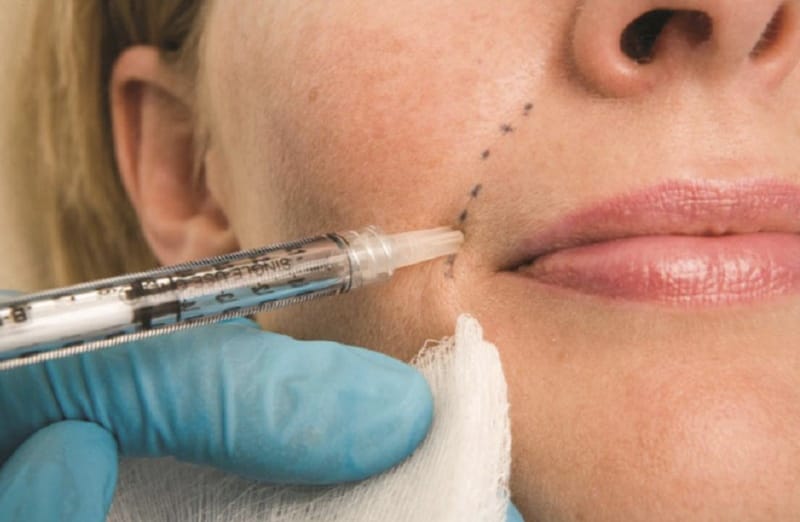
How long does it take for filler injections in smile lines to dissolve?
In cases where only mild swelling and stiffness occur, this usually disappears after 2-3 days, and the skin gradually softens and looks natural again. Conversely, if the condition persists and hardens into a lump, it may be a complication and requires immediate examination by a specialist.
The recovery time will depend on the severity. If not treated promptly, coupled with incorrect injection technique or the use of substandard filler, the risk of serious complications such as abscesses, infection, or necrosis is very high, making treatment difficult and prolonged.
Reasons for stiffness after smile line injections
Filler injections in smile lines are generally considered a low-risk beauty procedure, but complications can still arise if the filler is of poor quality, the doctor lacks experience, or the procedure is not properly performed. The phenomenon of a stiff, unnatural-looking face after filler injections often stems from the following causes:
Incorrect injection technique
Injecting fillers requires a thorough understanding of the skin and facial muscle structure. If injected too deeply, in the wrong location, or with an inappropriate amount of filler, the face can appear stiff and unnatural. Uneven distribution of filler can also make the injected area feel less flexible and heavy.
Body reaction and inflammation
Each person’s body is different, so post-injection reactions vary. Some people experience water retention, swelling, and a feeling of tightness, or even inflammation, causing the injected area to feel stiff and unnatural initially.

Choosing the wrong type of filler
Not all fillers are suitable for all skin areas. Using incompatible or low-quality products can easily cause the skin to become stiff and lose elasticity.
Some fillers decompose slowly and easily accumulate in the body, resulting in a less smooth appearance. Therefore, choosing a reputable filler with high biocompatibility is crucial to minimize the risk of facial stiffness.
How to fix stiff smile lines after filler injection
In cases where the skin shows slight swelling or stiffness after smile line filler injection due to the body not yet adapting, you can apply some of the following supportive measures:
- Cold compress: Wrap ice cubes in a clean towel and gently place it on the injection area for about 5 minutes to reduce pain and swelling.
- Steam or wash your face with warm water: Gentle warmth helps improve blood circulation, reducing the feeling of tightness. However, it’s important to maintain a safe distance, avoiding getting too close as this can cause the filler to dissolve quickly or damage the skin.
- Proper massage: Gently massage the area 2-3 times a day as directed by your doctor to ensure the filler doesn’t shift. Additionally, maintaining adequate rest and a nutritious diet will help your body recover quickly.

Signs that require a doctor’s visit at HBIO Clinic
Like other cosmetic procedures, filler injections for smile lines are not completely safe and still carry potential risks. If you notice the following symptoms, you should immediately visit HBIO Clinic for examination and appropriate treatment:
- Severe swelling and pain: Instead of just mild swelling or bruising as is common, prolonged swelling accompanied by severe pain is an abnormal sign.
- Infection: Widespread swelling and redness, increasing pain, pus formation, fever, and chills.
- Allergic reaction: Manifested by itching, rash, difficulty breathing, or facial swelling due to an intolerance to the filler.
- Filler migration: The filler material shifts from its original position, causing facial contour distortion.
- Loss of sensation: The skin around the injection site becomes numb, with reduced or complete loss of sensation.
- Skin necrosis: Although rare, it is dangerous; the skin may ulcerate or necrose, requiring immediate treatment.
Generally, the problem of stiffening or unnatural-looking smile lines after injections can stem from various causes, such as the technique used, the quality of the filler, or the body’s reaction. To minimize risks, you should choose a reputable facility with highly skilled doctors, such as HBIO Clinic, and strictly follow the post-injection care instructions to maintain a natural look.

Dr. Thai Nguyen – Founder and Medical Director of HBIO Clinic. As an expert in aesthetic dermatology, she regularly shares in-depth knowledge and practical experience to provide valuable and insightful information for those seeking better skin health.