Tiếng Việt
Tear troughs are deep depressions running from the inner corner of the eye down to the cheek. To improve this imperfection without surgery, many people have chosen natural daily methods. HBIO Clinic will explore this further in the article below.
The Effectiveness Timeframe for Tear Trough Removal Exercises at Home
The effectiveness of facial yoga (physical therapy) cannot deliver immediate results like cosmetic procedures. According to clinical studies from cosmetic and facial anatomy experts, the improvement process when performing tear trough removal exercises at home depends closely on the frequency and age of the skin:
- After 4 to 6 weeks of regular practice: Blood circulation under the eyes is stimulated to flow better. You will feel the skin around the eye sockets less tired, dark circles caused by blood vessel congestion are slightly improved, and the skin absorbs eye cream better.
- After 3 to 6 months of consistent use: The orbicularis oculi muscle and the levator palpebrae muscle begin to achieve a certain degree of firmness. For newly formed, shallow wrinkles caused by lifestyle habits (staying up late, computer stress), this home remedy for tear troughs will help to smooth the skin surface and significantly reduce sagging.
Popular and Easy-to-Do Home Exercises for Reducing Wrinkles
Exercising the facial muscle groups (facial yoga) helps stimulate better blood circulation, thereby supporting firmer skin around the eyes. You should regularly perform the following exercises daily:
Reducing wrinkles by stretching the orbicularis oculi muscle
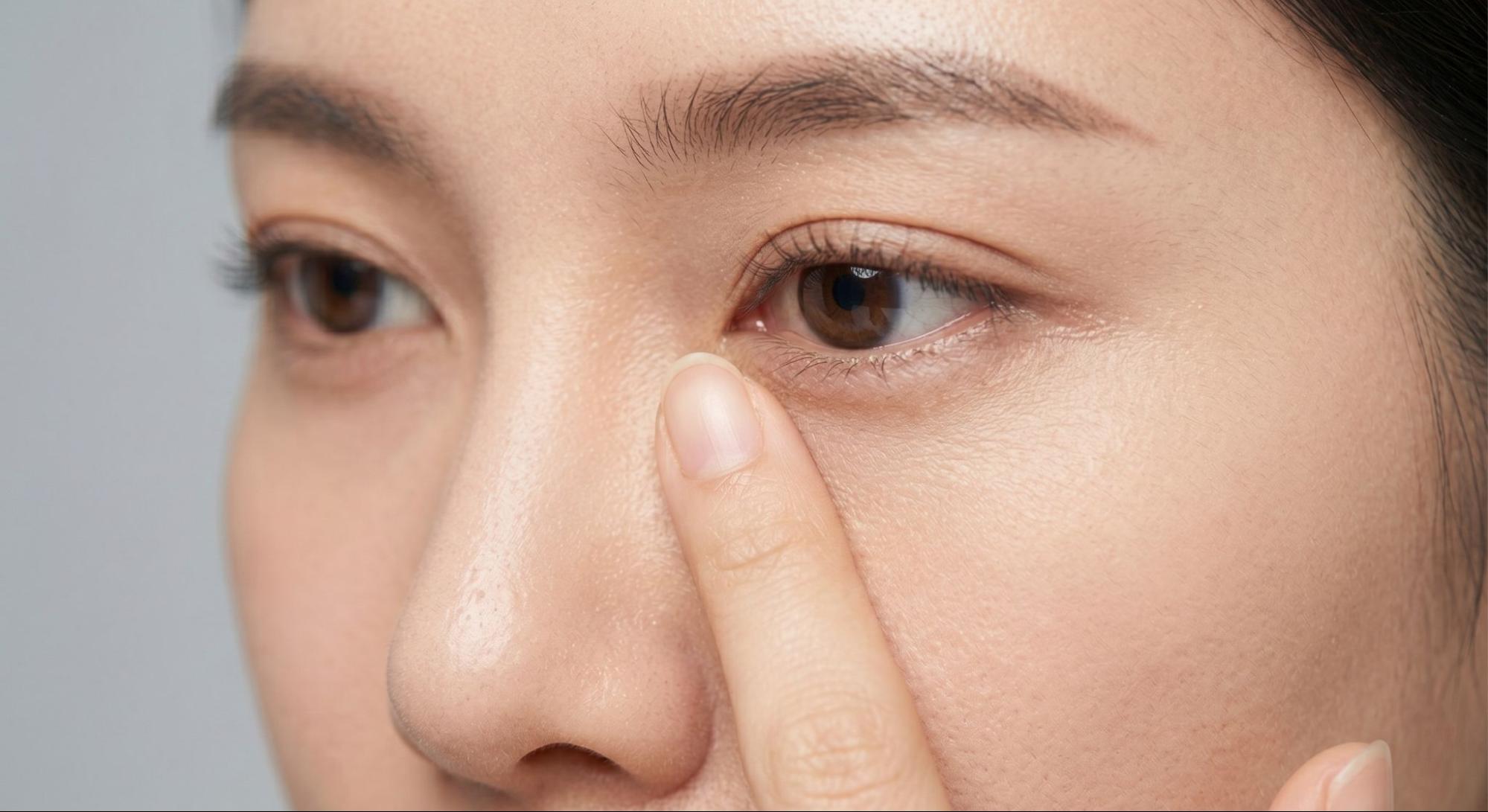
Place your index and middle fingers on the inner and outer corners of your eyes, forming a V shape. Press gently to hold, then look up at the ceiling and back down for 5 seconds. This action strengthens the lower eyelid lifting muscles.

Exercise to reduce tear troughs by gently massaging and lifting the muscles
Using your ring finger (the finger with the lightest pressure), dab a little moisturizer and gently massage from the inner corner of the eye along the tear trough towards the temple.

Here’s how to remove tear troughs at home, relieving tension in facial muscles and reducing puffiness around the eyes.
Tear trough removal exercise by stimulating circulation with fingertips
Use your fingertips to gently tap continuously around the eye socket bone in a circular motion. This movement helps the nutrients from eye cream penetrate deeper into the epidermis.

Continuous eye-rolling exercise to stimulate the eye muscles
Keep your head still and slowly roll your eyes clockwise 10 times, then reverse the direction 10 times.

Next, open your eyes wide for 5 seconds, then close them tightly for 5 seconds. This exercise helps to strengthen the small muscles around the tear duct system, preventing lower eyelid sagging.
Cheek muscle stretching exercise to relieve pressure in the lower eyelid crease
Open your mouth into a long “O” shape to tense the entire middle facial muscles, then use your two ring fingers to place in the tear duct area and gently pull upwards towards your ears.

Hold this position for 10 seconds and repeat 5 times to support the anterior cheek muscle stratification.
Benefits of Tear Trench Reduction
Although performing tear trench reduction exercises offers some improvements in blood circulation and muscle relaxation, you need to recognize that the effectiveness of tear trench reduction at home is often limited.
The core cause of deep tear trenches is the significant decrease in subcutaneous fat tissue volume and the breakdown of the deep collagen system due to the aging process.

Physical interventions at home to remove tear troughs can only affect the superficial muscle layer on the epidermis, and cannot compensate for the volume lost in the recessed area.
Therefore, for those with deep tear troughs due to congenital factors or severe aging, relying solely on exercises to remove them will not yield noticeable results.
The solution for deep tear trough removal at HBIO Clinic
To thoroughly and safely address the recessed tear trough area, intervention with advanced medical aesthetic therapies is necessary.
At HBIO Clinic, you will be examined directly by dermatologists, and your skin will be analyzed using advanced AI technology to determine the most optimal personalized treatment plan, completely replacing conventional tear trough removal exercises.
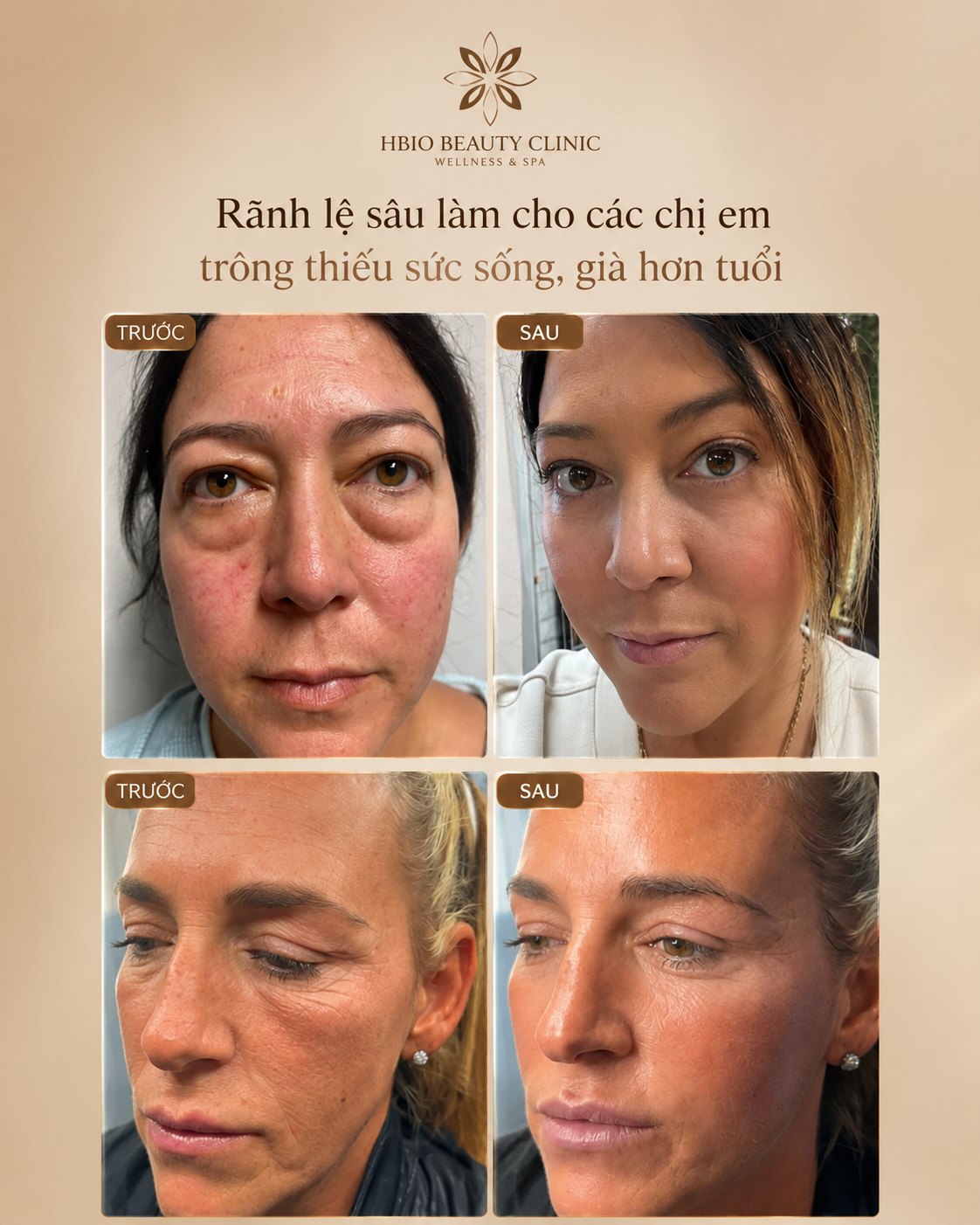
HBIO Clinic offers top-tier eye rejuvenation solutions:
- Filler injections to fill tear troughs: Doctors use genuine Hyaluronic Acid bio-active ingredients to precisely fill the sunken area.
- PLLA/PCL bio-stimulating injections: Introducing new-generation active ingredients into the dermis to stimulate the body’s own collagen production, helping to sustainably fill tear troughs and nourish the skin around the eyes for a smooth, firm appearance from within.
- Thermage FLX lifting technology: Deep-penetrating radio wave energy helps to contract loose collagen fibers, lifting the entire sagging lower eyelid area.
Instead of spending months persistently doing at-home exercises to remove tear troughs with unsatisfactory results, professional treatments at HBIO Clinic will help you regain radiant, youthful eyes safely and quickly.
Common dangerous mistakes when removing tear troughs at home
Many people are impatient to see quick results so they do it the wrong way, unintentionally turning tear trough removal exercises into a “double-edged sword” that causes the eye area to age faster. Here are common mistakes that you should absolutely avoid:
- Massage on dry, moisture-deficient skin: This is the most serious mistake. Rubbing your fingers directly on skin that lacks lubrication will create great friction, pulling and breaking the delicate collagen fibers in the epidermis, causing tear troughs to deepen and forming a series of tiny discolored wrinkles.
- Using the wrong fingers and using too much force: The eye area is 1/4 as thin as normal facial skin. Using your index finger or thumb to rub or squeeze hard because you think the force will help lift muscles quickly will tear the capillary system, causing bruising, swelling, etc.

- Incorrect stroking direction of muscle structure: The immutable rule when performing at-home tear trough correction is to always stroke horizontally from the inner corner of the eye and gently upward towards the temple.
- Overly high expectations for physical exercises: Believing that exercise can completely fill in congenital sunken eye sockets is a medical misconception. Insisting on incorrect exercise protocols for deep sunken eye sockets only wastes time and misses the “golden period” for recovery using advanced technology at HBIO Clinic.
Frequently Asked Questions about Tear Trough Removal Exercises
Do tear trough removal exercises completely eliminate congenital deep wrinkles?
No. Exercises only help to firm the superficial muscles; they cannot fill the hollow area caused by a congenital lack of fat tissue volume.
How long does it take to see improvement with at-home tear trough removal exercises?
For newly formed and shallow tear troughs, you need to consistently practice for 3 to 6 months combined with intensive moisturizing cream to see smoother skin texture.
Should people with sensitive skin use at-home tear trough removal massage?
Yes, but you must use extremely gentle movements with your ring finger and use a gentle, fragrance-free lubricant to avoid irritation.
After having tear trough filler injected at HBIO Clinic, do I still need to do facial muscle exercises?
No, it’s not necessary. After filler injections, you should avoid applying pressure or massaging the eye area vigorously for the first two weeks to allow the filler to stabilize and set optimally.
Youthful eyes are key to a radiant and confident facial expression. Practice exercises to reduce tear troughs if you notice them appearing. Furthermore, for the most medically sound and safe tear trough removal treatment plan, contact the experts at HBIO Clinic to schedule an appointment today!